


The coconut tree (Cocos nucifera) is one of the world’s most versatile and valuable plant species. Capable of producing food, fuel, cosmetics, building materials, growing media and cosmetic compounds, it’s no wonder that in the Philippines, the coconut is known as the Tree of Life. The global market for coconut products is predicted to reach $53.4 billion by 20331, thanks to annual growth rates of around ten per cent.
By Francisco Hernández Ortiz, Global Food Projects Director at HRS Heat Exchangers
The increasing demand for coconut products is driven by a number of factors, including the sheer versatility of the coconut palm itself. Consumers are more and more aware of the health benefits of coconut milk and water, while products such as cocopeat (coir) and coconut oil are more sustainable inputs for industries such as horticulture and cosmetics.
Increasing demand is not only boosting coconut production in traditional areas such as India, Sri Lanka, and Southeast Asia, but also accounts for new areas of production such as Latin America and Africa. At the same time, the development of local processing facilities is helping to increase production and export potential, while also ensuring that valuable revenues are kept in the local market.
Coconut’s multiple uses

Coconut oil accounts for the largest value of coconut-derived products (around 55%2), followed by coconut water (the fastest growing product), coconut milk, desiccated coconut and other products and co-products (such as coir). As an edible oil, not only does coconut oil have a unique fatty acid composition including the presence of healthy medium-chain triglycerides (MCTs), but it also has a high smoke point and distinct flavor.
As interest in plant-based alternatives to dairy products has increased, so has the demand for coconut products, with coconut milk being used in place of similar products such as cream. Coconut water is a natural electrolyte-rich drink, and a diverse range of varieties has evolved, such as flavored coconut water, coconut milk blends, and desiccated coconut. In addition, coconut flour and desiccated coconut are increasingly being used as gluten-free alternatives to wheat products in baking and other food applications.
A burgeoning demand for coconut products in the cosmetics, personal care and pharmaceutical sectors is being driven by the natural moisturizing properties of ingredients like coconut oil, which is recognized for its skin-friendly attributes.
As if this wasn’t enough, the fibers from the coconut husk are useful as a renewable growing media for gardeners and in professional horticulture; coconut sap can be used to make a range of products from vinegar and sugars to vegan nectar and honey alternatives; while palm fronds are often used locally for construction, making everything from baskets to boats.
Thermal processing considerations for coconut products
Coconut water
The wide range of coconut products means that many different processes are employed in their production. However, in many areas heat plays an important role. For example, coconut water (which is taken from fresh coconuts) reacts quickly once the coconut has been opened, meaning that aseptic processing and packaging are required. The HRS AF Series of aseptic fillers is ideally suited to coconut water, with a range of nozzle sizes and the ability to work with pre-formed and pre-sterilized bags of between 5 and 1,000 liters capacity.
At the same time, being 92-95% water, coconut water can be expensive to transport, so evaporation is often used to reduce volumes before shipping and further processing. A special version of the HRS Unicus Series is available for evaporation applications, utilizing a shell and tube heat exchanger with scraping rods in the interior tubes.

Coconut milk
Coconut milk and cream are produced from mature coconuts and as such, different products (light milk, milk, cream and cream concentrate) have different properties. They also react in different ways, meaning the correct choice of processing is crucial, particularly in terms of pasteurization. As with other plant-based milk alternatives, the HRS DSI Sterilizer, which uses direct steam injection to sterilize the product, brings a number of benefits. The system works by rapidly injecting steam into the product, instantly heating it to the ultra-high temperature. This is immediately followed by condensation in around 0.1 second, equalizing the temperature. Short heating time and high sterilization temperature ensures that product taste and colour are not damaged while microorganisms and spores are neutralized. Another consideration when processing coconut milk is that its fouling potential increases with treatment temperature3. Because coconut milk is a homogenized mixture of water and coconut flesh, it is also important that physical stresses do not result in shearing or separation of the product. This can mean that many scraped surface heat exchangers are too aggressive to be used. Conversely, corrugated tube heat exchangers, such as the HRS MI Series, or a gentle scraped surface heat exchange like the HRS Unicus Series (with its characteristic reciprocal action) are ideal for processing coconut milk.
Coconut oil
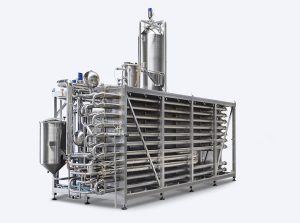 Coconut oil is extracted from the dried coconut kernels known as copra. Pre-treatment heating to between 40-60°C has been shown to not only improve oil yields, but also to deactivate some of the enzymes in the oil, which could otherwise affect the final quality. Depending on the end use, it may be subject to a wide range of subsequent processing including hydrogenating, degumming, deacidification, decolorization, and deodorization – all of which need accurate temperature control at a range of different temperatures.
Because many of these processes also generate large quantities of steam, there is significant scope to install heat exchangers to condense this steam for reuse, and many systems will be designed to maximize energy recovery (energy regeneration) to improve overall energy efficiency and reduce costs. With more than forty years’ experience in the thermal processing of vegetable oils and coconut products, HRS Heat Exchangers has a wide selection of both standalone heat exchangers and integrated systems for use in coconut processing. Contact us today so we can help you find the optimal solution for your requirements.
References:
[1] https://www.imarcgroup.com/coconut-products-market
[2] https://www.grandviewresearch.com/industry-analysis/coconut-products-market
[3] Narataruksa, P., et al. (2010) Fouling behaviour of coconut mil at pasteurization temperatures IN Applied Thermal Engineering. Available at https://www.sciencedirect.com/science/article/abs/pii/S1359431110001055
About the author
 After graduating as an industrial technical engineer from the universidad Politécnica de Cartagena (in Murcia, Spain) in 1990, Francisco worked in the refrigeration, air conditioning and food machinery manufacturing sectors. He joined HRS Heat Exchangers in 1994 as a Design Engineer and played a crucial role in developing the Engineering Office in the rapidly expanding company. In 2010 Francisco was appointed as the global Food business Director for HRS. In this role he supports the various HRS Group sales offices around the world. His extensive technical knowledge, acquired during his years as a design engineer, along with his ability to understand the needs of the client, have made Francisco one of the top experts in the food processing industry.
About this Featured Story
Why Subscribe?
Featured Stories are regularly shared with our Heat Exchanger World community. Join us and share your own Featured Story on Heat Exchanger World online and in print.