

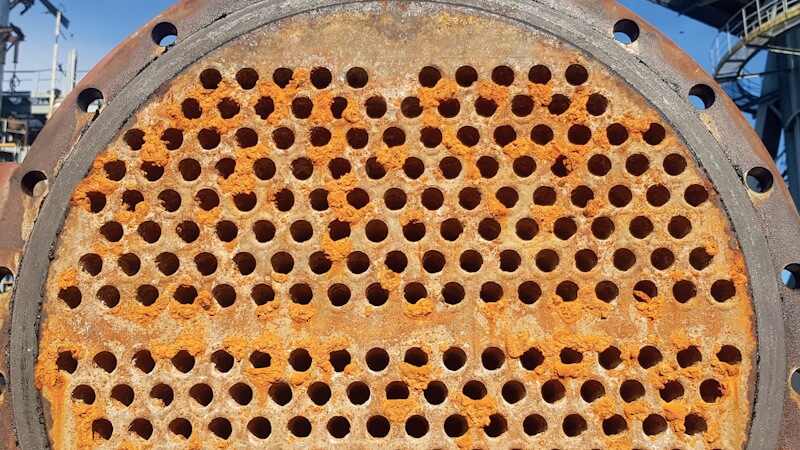

Synthetic biology is transforming industries by engineering microorganisms to solve pressing global challenges. Among these is biofouling in heat exchangers, a problem that reduces efficiency, drives up energy use, and contributes significantly to carbon emissions. Maastricht University’s iGEM team, CoreSpin, is developing an innovative spider silk–based solution to prevent biofilm formation and improve heat exchanger performance.
By Katya Mannar and Antonin S´migiel, CoreSpin, Maastricht University
From the food we eat to the clothes we wear, to the medicines we take, synthetic biology is quietly shaping our modern life. This rapidly advancing field of science entails the engineering of natural microorganisms and eukaryotic cells to either optimise their native properties or to introduce novel functions through the redesign of a cell’s genome (Roberts et al., 2013). While grounded in biological principles, the realm of synthetic biology extends beyond the traditional disciplines of biology. Situated at the interface of science and industry, synthetic biology is a highly interdisciplinary field of research which aims to merge the knowledge of life sciences together with principles from engineering, computer science, and chemistry, amongst others, to design and construct biological systems (Andrianantoandro et al., 2006). As such, synthetic biology promises a deeper understanding of living systems and the capacity to reinvent them for a given application. Drawing on natural processes, this makes synthetic biology a major driver in transitioning towards a sustainable circular economy through providing innovative solutions for the burning issues of our time (Hassard et al., 2024).
Applications and potential of synthetic biology
A simple bacterium like E.Coli, which is present every human being’s , can be modified to have wholly synthetic genetic material to induce a desired protein expression pathway, or even introduce an entirely ex-situ component.
This variability allows synthetic biology to be moulded for different applications, meaning that world-changing research could be one custom DNA set away. Synthetic Biology is already in use currently, enabling the production of a life-saving treatment like insulin at a rapid pace (Baeshen, 2014). However, its potential also reaches into offering more sustainable solutions to current industrialised practices. For example, biomining enables cells to extract metals from waste, allowing them to reenter the usage cycle (Schippers, 2014).
iGEM and the Maastricht University team
Competitions like iGEM, which stands for International Genetically Engineered Machine, encourage university and high school students from around the world to solve specific issues using synthetic biology. This year’s team from Maastricht University in the Netherlands is interested in using synthetic biology to prevent biofouling of heat exchangers.
Biofouling in heat exchangers
Biofouling is a critical issue for heat exchangers everywhere, like those present in large-scale manufacturing plants and data centres, with heat exchanger fouling alone accounting for a loss of 0.25% of GDP of industrialised countries (Zettler, 2019). Biofouling occurs when dense networks of bacteria, biofilms, adhere to a specific surface. These biofilms contain a high water content, providing unintentional thermal insulation when growing on heat exchangers, with a 0.1mm thick biofilm potentially decreasing thermal conductivity by up to 98% (Rosser, 2024).
The heat exchanger system has to essentially overwork itself to compensate for the loss of heat transfer and to maintain the same level of efficiency. Some estimations report the fouling of heat exchangers are responsible for 1-2.5% of global CO2 emissions (Zettler, 2019) (Müller-Steinhagen, 2009). As a way of amending this loss in efficiency, many heat exchangers have an integrated structure of being 70-80% larger than required because of biofilms (Bansal and Chen, 2006).
CoreSpin’s approach to the problem
Initially becoming aware of the problem through a contact from Dell Technologies, Maastricht University’s 2025 iGEM team decided to look at their own university’s energy centre and found that this issue was also present on a smaller scale. Current methods to clean heat exchangers, face issues with accessibility, time, cost and damage to the infrastructure at hand (Shaurya, 2024).
Their team CoreSpin attempts to eliminate these issues in the first place, attempting to create a preventative solution to heat exchanger fouling.
Spider silk as a potential solution
CoreSpin was particularly interested in spider silk, because its exceptional properties made it stand out from other biological materials. Spider silk has impressive characteristics with its tensile abilities similar to that of steel when put into reference per unit of weight (Römer, 2008). Proteins from the dragline silk which spiders produce, have shown high thermal conductivity comparable to that of copper (Huang, 2012). CoreSpin is attempting to attach these dragline spider silk proteins to heat exchanger plates, as a way of providing a biostatic environment for the prevention of microbial attachment, dust particles, and pollen. The attached proteins will form a layer that can maintain a heat transfer efficiency as high as that of an unfouled heat exchanger. This spider silk protein layer will act as a preventative solution to biofouling, while also assisting in optimal heat exchange. Currently, CoreSpin is investigating which composition and structure of spider silk proteins meet their needs for maximum efficiency and functionality.
References are available upon editorial request.
About CoreSpin
CoreSpin consists of a group of 14 undergraduate science students from Maastricht University who are passionate about learning and research. They are currently headed by their supervisors, Dr. Erik Steen Redeker and Dr. David Cortens, and are excited to present their research to a panel of judges during the iGEM Grand Jamboree in October.
About this Featured Story
Why Subscribe?
Featured Stories are regularly shared with our Heat Exchanger World community. Join us and share your own Featured Story on Heat Exchanger World online and in print.