

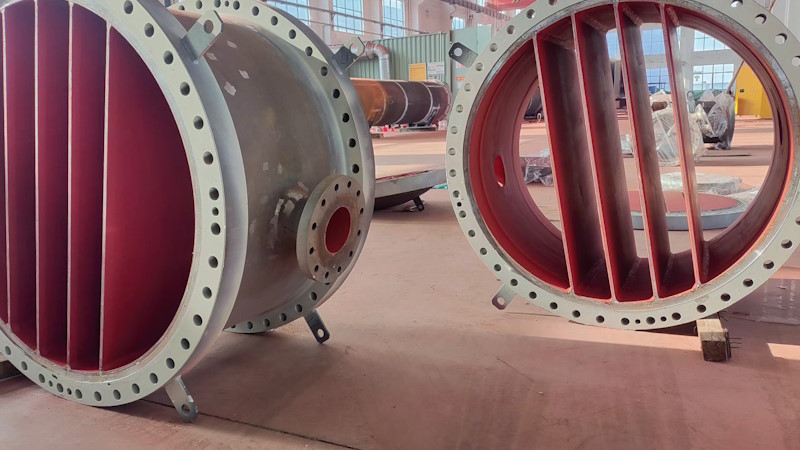

Heat exchanger water boxes coated with SÄKAPHEN HR 60 Extra TG. Source: SÄKAPHEN GmbH
Any company operating heat exchangers knows it: these systems run a high risk of corrosion and incrustation, which may cause a loss or drop in performance and lead to increased operating or investment costs. SÄKAPHEN offers a simple and economically viable solution: protective coatings.
By Chiara Foppa Pedretti for SÄKAPHEN GmbH
Heat exchangers are critical components whose efficiency and longevity are frequently compromised by internal corrosion and fouling, which can lead to increased operational costs and a loss of performance. A strategic solution to these challenges is the internal lining of heat exchangers with specialized protective coatings. This technical solution offers significant benefits in terms of protection, operational efficiency, and ecological sustainability.
Protection and longevity
The primary function of a high-performance coating is to provide robust corrosion protection. Heat exchangers are often exposed to highly aggressive media, such as conditioned and unconditioned cooling water, and extreme temperature fluctuations. Applying a heat-cured, thermosetting lining, such as SÄKAPHEN’s ones based on phenolic or epoxy-phenolic resins, creates a protective barrier that is resistant to both highly acidic and alkaline substances. This barrier prevents the underlying substrate from corroding, even in harsh immersion and gas phase conditions.
These linings can also prevent galvanic corrosion, a common issue where dissimilar metals, like those used in tubes and tube sheets, are in contact. The insulating properties of the coating effectively separate these metals, stopping the electrochemical reaction that causes corrosion. By preventing corrosion, these linings not only extend the service life of the equipment but also allow for the use of more economical materials like carbon steel, significantly reducing initial capital costs. Christoph Fischer-Zernin, Commercial Director at SÄKAPHEN, mentions one of the successful application cases of which he is most proud: “As soon as that special request from a major chemical manufacturer landed on our desks, we knew it would entail an unprecedented challenge for us. That is why we immediately chose a best-in-class product from our heat-cured linings range and turned to one of our trusted authorized applicators. The customer needed to recover and re-coat 86 high-pressure pipes for a large-sized heat exchanger. Their surfaces operated in contact with aggressive cooling water (shell side) and corrosive solvent over 100 °C (tube side). As the shell-side coating, we opted for our Si 57 E, a hydrophobic, heat–cured, epoxy-phenolic based lining with excellent chemical resistance and capable of preventing caking, fouling and incrustation.” The results? “Long-term plant efficiency and reliability, maximum operational safety, and an outstanding return on investment (ROI),” Fischer-Zernin states.
Operational and economic efficiency
Indeed, the operational benefits of lining heat exchangers are directly tied to improved performance and reduced maintenance. The key is the smooth, hydrophobic surface of the applied lining, which typically has a surface roughness of just 1 to 2 microns. This ultra-smooth finish significantly reduces fouling and incrustation, which are the buildup of deposits that impede heat transfer and restrict flow. By minimizing this buildup, the coating leads to a reduced pressure drop and an improved flow speed, lowering the energy consumption required for operation.
Christoph Fischer-Zernin explains: “The impact of these improvements is best understood through the Total Cost of Ownership (TCO). When comparing a coated carbon steel heat exchanger to one made from more expensive materials like stainless steel or titanium, the initial investment for the lined carbon steel unit is considerably lower. Over its lifespan, the reduction in cleaning, repair, and replacement costs due to enhanced protection makes the coated carbon steel option the most economical choice. This benefit is particularly pronounced in services with aggressive water types, such as river or sea water.”
The ecological advantage
The implementation of high-performance coatings also contributes to a company’s ecological footprint. The improved thermal and hydraulic efficiency of a lined heat exchanger translates directly into lower energy consumption. By optimizing the heat transfer and reducing the power required to pump media through the system, the operational carbon footprint is reduced. Additionally, by dramatically extending the operational lifespan of the equipment, the need for frequent replacement is eliminated, conserving raw materials and energy associated with the manufacturing and disposal of new units. This lifecycle extension is a core component of sustainable industrial practice.
“An outstanding example of this,” notes SÄKAPHEN’s Commercial Director, “was the case of a German thermal solutions expert company, a manufacturer of coolers, condensers, economizers and heat transfer systems. When it was required to build a new shell-and-tube heat exchanger similar to two units manufactured in the past and still in use, whose internal lining had never presented a single issue, it realized that those two systems had been lined with a SÄKAPHEN heat-cured epoxy phenolic product back in 1986: that is thirty-nine years of honorable service! Of course, they had no doubts: the new heat exchanger also had to be treated with a SÄKAPHEN coating.”

Heat exchanger tubes coated with SÄKAPHEN Si 57 E. Source: SÄKAPHEN GmbH
The application process
The application of these specialized coatings calls for a meticulous, multi-step process that ensures a high-quality and durable result and that, in this case, is performed directly by SÄKAPHEN or by one of its authorized applicators distributed over four continents.
It begins with thorough surface preparation, which involves cleaning and grit blasting the metal to be treated. This stage removes all contaminants and old coatings, creating a profile for optimal adhesion. Following preparation, the lining product is applied in multiple coats until the desired dry film thickness (DFT) is achieved. For heat-cured coatings, a polymerization oven is used for curing phases between each coat; this partial curing process builds a robust, multi-layered film. After the final coat is applied and cured to the target DFT, a rigorous quality control process is performed. This often includes holiday or spark testing to detect any pinholes or defects in the lining. Any imperfections found are repaired before the final, complete heat-curing phase and the preparation of all required documentation.
Conclusions
“The internal lining of heat exchangers is not merely a maintenance task,” says Christoph Fischer-Zernin, “but a strategic decision that yields tangible benefits in protection, efficiency, and sustainability. The use of specialized coatings allows for cost-effective material choices while providing long-term protection against corrosion and fouling. And, by reducing energy consumption and extending asset life, it also delivers a strong financial and ecological advantage. That is why SÄKAPHEN is committed to providing a wide range of proven heat-cured and cold-cured protective coatings developed to meet these exact challenges and enhance the performance and longevity of critical heat exchange equipment.”
About this Featured Story
Why Subscribe?
Featured Stories are regularly shared with our Heat Exchanger World community. Join us and share your own Featured Story on Heat Exchanger World online and in print.