

Ensuring the reliability of tube-to-tubesheet joints is vital to the performance and longevity of heat exchangers in industrial operations. This article explores how combining hands-on repair experience with finite element analysis (FEA) enhances understanding of joint behavior under various mechanical and material conditions. The study delivers practical insights and validated repair strategies that align with industry standards to improve maintenance outcomes and equipment reliability.
By Fawaz Al-Khuliawi, Corporate Maintenance Engineering Consultant, Saudi Aramco
This article presents a comprehensive study on the repair and performance evaluation of tube-to-tubesheet joints in heat exchangers, combining practical repair case histories with a finite element analysis (FEA) modeling approach. Focusing on shell-and-tube and air-cooled heat exchangers, it highlights maintenance challenges, introduces validated repair methods, and explores the influence of key joint parameters such as wall reduction, material strain hardening, and initial clearance. Drawing on over two years of in-house heat exchanger repair experience at Saudi Aramco, the paper reinforces the importance of standardized procedures and advanced simulation techniques in achieving long-term equipment reliability. It aligns with TEMA and Saudi Aramco standards, providing refined guidance for industry professionals on optimizing joint integrity, reducing downtime, and improving mean time between failures (MTBF).
Introduction
Heat exchangers are components in the operational framework of petroleum and power plants. Their failure can result in significant operational downtime and financial loss. The heat exchanger shop at Saudi Aramco has consistently provided reliable, cost-effective, and timely maintenance services, repairing an average of 289 units annually over the last five years with a 45-day turnaround time.
Routine maintenance planning is crucial to minimize unplanned shutdowns. A common dilemma during maintenance involves deciding whether to:
- Replace individual tubes,
- Perform partial retubing, or
- Fully retube the bundle
The decision is driven by safety, cost feasibility, and unit reliability. Failures in tube-to-tubesheet joints are among the leading causes of operational inefficiency, primarily due to corrosion, erosion, thermal cycling, or vibration.
Repair practices: Step-by-step breakdown
The shop maintenance process adheres to a systematic procedure compliant with Saudi Aramco and international standards:
- Receiving and Documentation:
- Verification of the vessel against documentation
- Recording of design specifications and repair history
- Dismantling and Cleaning:
- Removal of damaged components
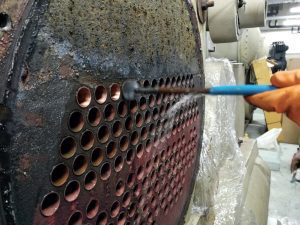
- Steam cleaning of tube bundles and components
- Inspection and Evaluation:
- Visual and dimensional inspections
- Non-destructive testing where applicable
- Repair Execution:
- Fabrication or overlay of tubesheets
- Welding damaged threads
- Mechanical expansion and welding of tube joints
- Reassembly and Hydrotesting:
- Boxing-up components
- Leak and pressure testing to verify integrity
- Common tube-to-tubesheet repair tasks include:
- Tube expansion: Controlled mechanical rolling using torque-regulated expanders
- Seal welding: Applied where joint sealing is critical. Weld thickness ≤ 1.4 × tube wall thickness
- Strength welding: Used in high-stress environments where joint strength is paramount. Weld thickness ≥ 1.4 × tube wall thickness
Finite element analysis (FEA) approach
Finite Element Analysis (FEA) was conducted to evaluate the behavior of tube-to-tubesheet joints, which are critical to the performance and reliability of heat exchangers in petroleum applications. The study investigated how various tube expansion parameters—including material properties, wall reduction, and initial clearance—affect joint strength. Performed in accordance with TEMA and Saudi Aramco standards, the FEA focused on the role of residual contact pressure and provided valuable insights for enhancing joint design and repair strategies.
The FEA study focused on:
- Geometry: Tube outer diameter of 19.05 mm and wall thickness of 2.1 mm.
- Materials: ASTM 179 seamless low-carbon steel for tubes and ASTM A516G70 carbon steel for tubesheets.
- Parameters Studied
- Initial radial clearance: 0 to 0.5 mm.
- Wall reduction: 1% to 12%.
- Tangent modulus for strain hardening: 0 to 1.2 GPa.
An axisymmetric 2D model was created using ANSYS software, simulating roller expansion and evaluating residual contact stress. The model was validated against experimental data using pullout force measurements.
Validation
The FE results were validated against experimental data, using pullout force measurements as a proxy for joint strength. The pullout force is proportional to the residual contact stress and expanded length of the joint.
Findings and results
 Effect of initial clearance
- For low-strain-hardening materials, the residual contact pressure remained nearly constant within the TEMA allowable clearance of 0.16 mm (0.0063 in.).
- A sharp decline in joint strength was observed when the clearance exceeded critical values. The critical clearance showed an inverse relationship with the tube’s strain-hardening capability.
- Elastic-perfectly plastic materials (Ett = 0 GPa) exhibited a gradual decrease in residual contact pressure as clearance increased, whereas strain-hardening materials demonstrated an initial increase followed by a drop at higher clearances.
Effect of wall reduction
- Residual contact pressure increased sharply between 1% and 3% wall reduction for all material strain-hardening levels.
- Beyond 3% wall reduction, residual pressure trends diverged:
- Decreased for elastic-perfectly plastic materials.
- Increased for strain-hardening materials, with a slope proportional to the strain-hardening level.
- Tubesheet material influence: The strain-hardening level of the tubesheet material had negligible impact on joint strength due to the absence of plastic deformation in the ligament at 5% wall reduction.
Conclusion
FEA results and repair practices emphasize the need to optimize design and maintenance by selecting materials with proper strain hardening and using advanced techniques like phased array testing. Industry standards, such as TEMA’s 5% wall reduction, generally ensure joint strength, but adjustments based on material and operational factors are essential to avoid over-expansion or excessive clearance.
The study confirms the critical role of clearance, wall thinning, and material behavior in joint integrity. The validated FE model supports predictive accuracy and enhances existing standards, contributing to improved heat exchanger joint design and fabrication.
 About the author
 About the author
Fawaz Al-Khuliawi is a Corporate Maintenance Engineering Consultant at Saudi Aramco with extensive experience in project management, plant maintenance, and vendor engagement.
He holds a Mechanical Engineering degree from KFUPM and an MBA. He is a Chartered Engineer (IMechE), a CMRP, an AVS-certified specialist, and a registered Consultant Engineer with the Saudi Council of Engineers.
References
- Standards of Tubular Exchanger Manufacturers Association, Ninth Edition, 2007
- Carl Andreone, Stanley Yokel “Tubular Heat Exchanger, Inspection, Maintenance and Repair”, 1997
- API 510 8th Edition, “Pressure Vessel Inspection Code: Maintenance Inspection, Rating, Repair, and Alteration
- Alaboodi, A. S., Merah, N., Shuaib, A. N., & Al-Nassar, Y. “Modeling the Effects of Initial Tube-Tubesheet Clearance, Wall Reduction, and Material Strain Hardening on Rolled Joint Strength.” Journal of Pressure Vessel Technology, 2008.
- Saudi Aramco/Mechanical Services Shops Department;
- H-03 Heat Exchanger Technical Testing Procedure
- H04 Shop Heat Exchanger Tube To Tubesheet Joint Procedure,
- H05 Heat Exchanger Tubesheet Overlay Procedure,
- SAEP-317 Testing and Inspection (T&I) of Shell and Tube Heat Exchangers.
About this Technical Story
This Technical Story was first published in Heat Exchanger World Magazine in October 2025. To read more Technical Stories and many other articles, subscribe to our print magazine.
Technical Stories are regularly shared with our Heat Exchanger World community. Join us and share your own Technical Story on Heat Exchanger World online and in print.