

The manufacturing, transport, assembly, and maintenance of industrial heat exchangers all require the lifting, turning, and rotating of heavy equipment. However, the lifting technology used does not always comply with safety requirements. Improvements are often needed, particularly with regard to lifting points, not least due to liability risks. The right solutions have long been available.
By Fabian Bihlmaier, Head of Engineering and Development at RUD
Professional lifting points for standard-compliant lifting, rotating, and turning
Handling industrial heat exchangers involves lifting, turning, and rotating equipment, which can often weigh several tonnes, on a daily basis. This begins at the manufacturing stage. For example, before welding the jackets or housings of rotationally symmetrical heat exchangers, it is necessary to ensure that they are lifted and lowered safely on the roller blocks of welding rotators. When preparing equipment for transport, it often needs to be set up vertically or tilted horizontally, and positioned precisely on pallets or in containers. The requirements are even higher during assembly.
In order to insert heat exchangers into complex piping systems or narrow machine rooms, and to align their inlet and outlet openings precisely, high-precision lifting, rotating, turning and positioning are essential. These procedures are also vital for maintenance and cleaning processes. To remove encrustations or fouling from the equipment, it often needs to be removed and positioned so that the cleaning openings are accessible. Even visual inspections for cracks or corrosion require repeated rotation into different positions, as this is the only way to reach and inspect all surfaces.
High-performance lifting technology is vital
These numerous lifting, rotating, and flipping actions can only be executed successfully if high-performance lifting technology is used. It provides the necessary flexibility to move the heat exchangers precisely, while ensuring the required level of safety for people and materials. In fact, uncontrolled movement or crashes can have devastating consequences. For example, if one of the multi-tonne machines crashes uncontrollably into the complex piping of an industrial plant, the damage could easily run into the millions. In the worst-case scenario, falling cargo can result in serious or even fatal injury. Such incidents can be prevented by expertly selecting lifting solutions that ensure the low-risk movement of heat exchangers during manufacturing, transport, assembly, and maintenance. Therefore, manufacturers and users have traditionally aimed to implement such lifting solutions, thereby creating the conditions necessary for the responsible handling of heavy equipment in all application scenarios.
Lifting points often fall short of normative specifications
Despite the obvious efforts to find safe solutions, professional lifting standards are not always met in practice. This applies in particular to the lifting points, which are crucial for any safe lifting solution. They are attached to the heat exchangers either temporarily or permanently. They serve as attachment points for lifting chains or straps, and they must be designed to support the total weight of the heat exchanger, including all attachments. This means that they must be able to safely bear the load during lifting, rotation, and turning processes. However, this is by no means guaranteed everywhere. Large and heavy heat exchangers used in process and energy technology often have simple self-made padeyes or lever tabs as lifting points, which are often cut directly from the heat exchanger housing by the user to save money. These in-house solutions almost always lack the defined WLL and safety factors, and application-related certifications are also usually missing. This poses a safety risk and contradicts the international standards outlining best practice for the design and safety of lifting points. These standards are also relevant in terms of liability law. Both DIN EN 1677 and ASME B30.20 stipulate that the load capacity and safety factors must be indicated, such as four times the safety factor against breakage. In extreme cases, the lifting point must therefore be able to withstand a load four times greater than its official WLL. Furthermore, both standards stipulate that lifting points must be suitable for the intended operating environment. This can only be demonstrated through certification.
The legal situation requires professionalisation in accordance with the relevant standards
If these normative requirements are circumvented, it is not just a legal grey area; it is actually entering the proverbial red zone. Anyone who relies on untested self-made padeyes or lever tabs is effectively violating safety regulations and could be held legally responsible for any damage caused. This applies not only to the heat exchanger manufacturer, but also to industrial users, as well as to shippers, transporters, and crane operators commissioned by them. The fact that not everyone involved is always aware of this circumstance does not provide any protection, since ignorance does not exempt anyone from their liability obligations. Therefore, for manufacturers and users of industrial heat exchangers, there is practically no alternative to professionalising the area of lifting points and abandoning mostly non-standard self-made solutions. However, the focus should not be solely on the WLL, design factors, and certifications. Instead, aspects such as the number, arrangement and position of the lifting points must be considered. For instance, multi-point suspensions that have been carefully calculated are often required to ensure an even distribution of load during lifting, as well as controlled rotation and turning movements.
Furthermore, care must be taken to ensure that the positioning of the lifting points does not result in incorrect loads being applied to critical components, such as tube bundles or housings, which could lead to deformation. Depending on the installation situation, frame reinforcements on the heat exchanger may also need to be considered. Even the best lifting point will be ineffective if the attachment area cannot withstand the WLL. The number, arrangement, and position of the lifting points must therefore be considered in the design of the heat exchangers, and must be carefully planned and calculated, even if the lifting means are only ever installed temporarily.
Practice-related planning prevents poor investments
Such planning should be consistently based on the deployment scenarios that are realistically expected. This prevents both unpleasant surprises and bad economic investments. Even in the professional sector, not all lifting points are the same. For safety reasons, it is generally advisable to avoid low-budget models and instead rely on quality features as standard. Market-leading specialists like RUD consistently offer these features, including high-quality lifting points with clear markings, a defined WLL, four times the safety against breakage and corrosion-protected bolts made of patented steel grades.
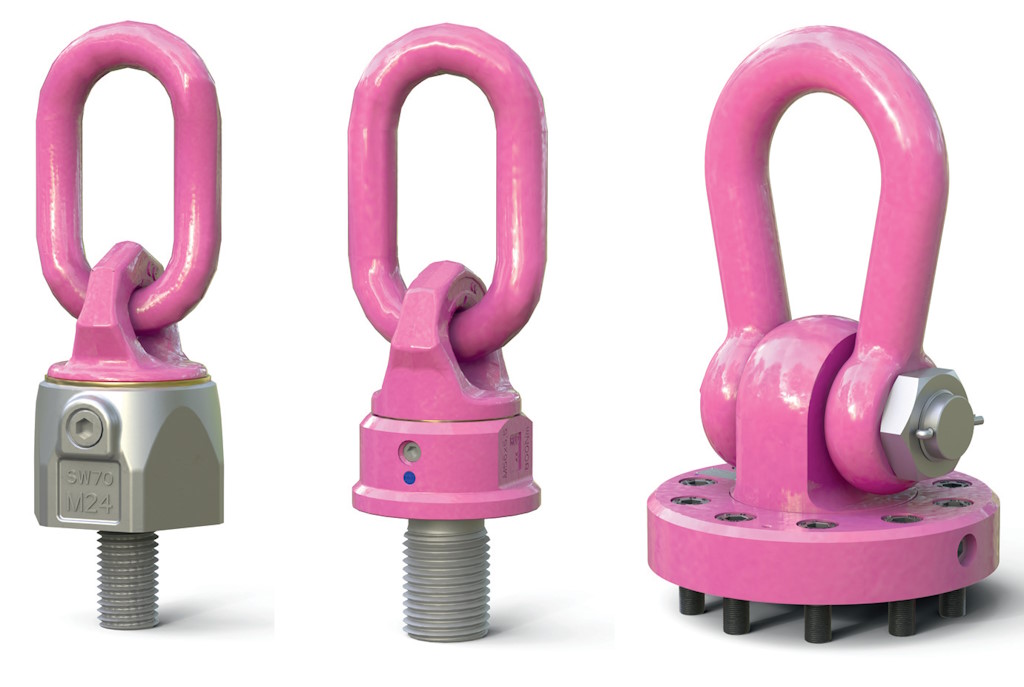
However, it is not entirely necessary to invest in a high-end solution for all applications, even under these conditions. For example, if lifting without major changes in position is all that is required during preparation for transport, and installation and removal during assembly and maintenance do not involve rotating or turning – such as when inserting the heat exchanger horizontally into a frame – then stable load rings such as the RUD VLBG load ring with a 10.9 threaded bolt or the RUD VLBG-PLUS are perfectly adequate. With capacities ranging from 0.3 to 4 tonnes and 0.63 to 20 tonnes, they provide a robust and cost-effective solution for a variety of standard lifting operations involving heat exchangers. Their compact design is also advantageous in confined spaces, such as when loading containers.
The solution options: Load ring – swivel hoist ring – ACP-TURNADO
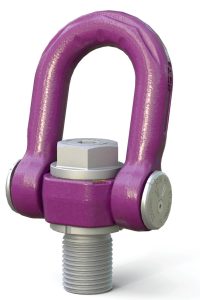
Image source: RUD.
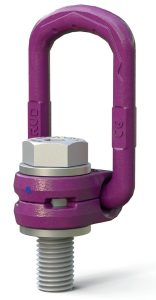
The situation is different when significantly more dynamic lifting processes involving increased changes of direction, as well as rotating or turning under load, are to be implemented. In such cases, ball-bearing swivel hoist rings are recommended instead of load rings, since they allow for greater flexibility of movement and are also suitable for heavy loads. Proven solutions such as the VWBG-V, VWBG and WBPG from RUD cover load ranges between 0.3 and 250 tonnes. They can be rotated 360° vertically and horizontally under load and rotatable by 230° (VWBG and VWBG-V) or 180° (WBPG for heavy loads). Furthermore, they can withstand a WLL at a 90° angle to the load ring plane, which is sometimes unavoidable during rotating movements (in the case of WBPG, this takes into account special load factors). This enables controlled rotating, positioning, tilting, and turning at any time, even with extremely heavy industrial heat exchangers.
Ball-bearing swivel hoist rings are not the ultimate solution for every handling situation.
If heat exchangers are produced on automated production lines, where they are moved by a gantry crane or robot during processes such as welding, or if they require frequent turning in different directions during assembly and maintenance, a high-end lifting point such as the RUD ACP-TURNADO may be a better choice. Its 360° swivel joint at the lift bail axle and integrated spring mechanism ensure the 180° swivel lift bail always aligns automatically in the direction of pull, rather than temporarily remaining in a transverse position. This prevents the dreaded shock loads, which occur when the lift bail suddenly flips, causing the load to drop in a whiplash-like manner. This uncontrolled movement can seriously endanger people, and can damage the heat exchanger, the system and the crane technology. In the worst-case scenario, there is a risk that the lifting chain could break, causing the multi-tonne load to fall. A swivel joint and spring mechanism prevents such scenarios, ensuring maximum user safety. This makes the ACP-TURNADO the best possible solution for industrial heat exchangers, particularly given that the available lifting point exceeds the requirements of DIN EN 1677 for loads from 0.7 to 32.5 tonnes. With design factors of 4:1 and 5:1 (four or five times the safety against breakage), it even meets the stringent requirements of the American standard ASME B30.26.
Conclusion
Whichever lifting point manufacturers and users ultimately choose, it is crucial that they are permanently aware of the fundamental importance of standards-compliant designs.
They must therefore no longer opt for solutions that contradict safety regulations and endanger people and materials. This also involves paying close attention to certifications, particularly in harsh environments, which provide reliable documentation of suitability for the intended application. For example, in heat exchangers operated in highly corrosive maritime environments – i.e. on ships and drilling platforms or in coastal power plants and desalination plants – only lifting points with DNV certification should be used. Such certifications are available for lifting points such as the RUD VLBG load block thread with 10.9 bolt, the RUD VLBG-PLUS (from size M30) and the RUD ACP-TURNADO (ACP-TURNADO OCEANSTAR version). These guarantee the permanently safe handling of multi-tonne equipment, even in maritime operating areas.
The same criteria should also be applied to lifting points for heat exchangers in chemical and petrochemical plants, as well as in hightemperature areas of the steel industry. There are suitable solutions readily available for such environments; manufacturers and users simply need to implement them.
About this Technical Story
This Technical Story was first published in Heat Exchanger World Magazine in February 2026. To read more Technical Stories and many other articles, subscribe to our print magazine.
Technical Stories are regularly shared with our Heat Exchanger World community. Join us and share your own Technical Story on Heat Exchanger World online and in print.